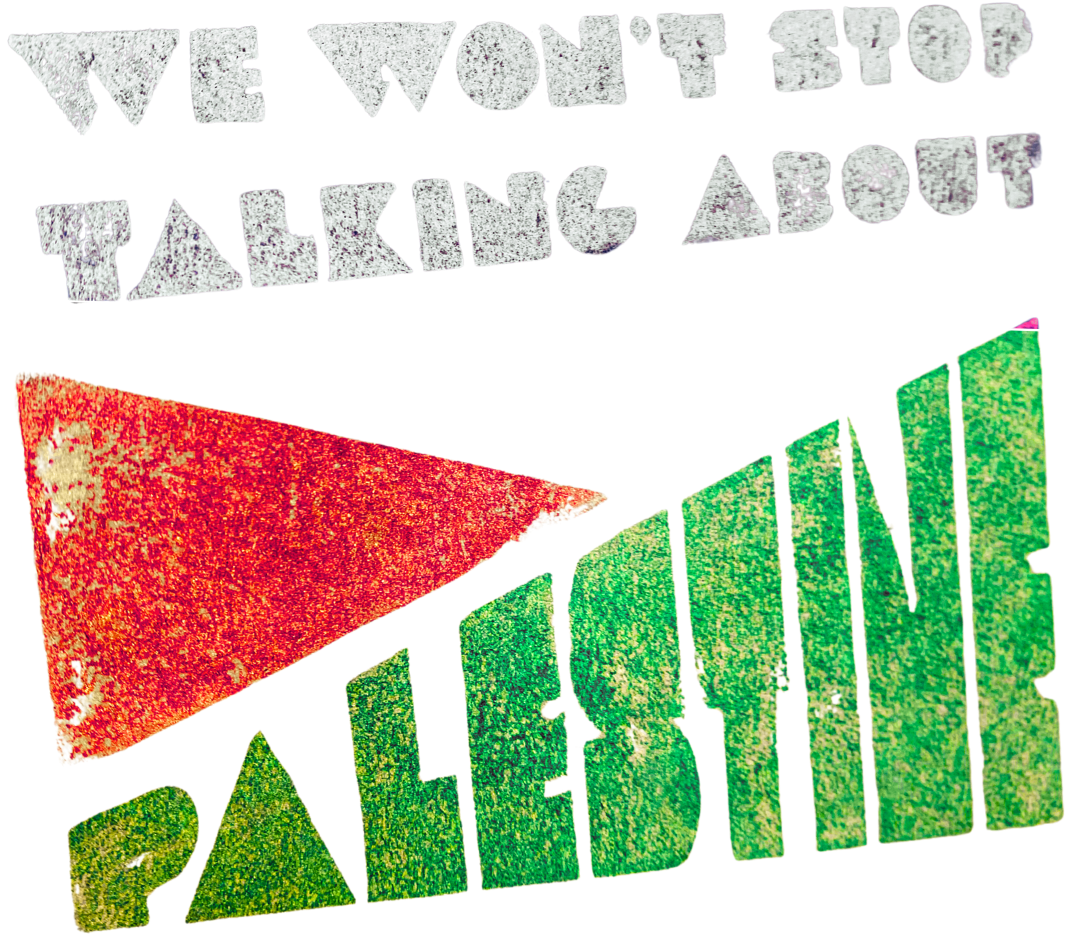
We refuse the so-called Palestine Exception, a term referring to how public discourse and the law are manipulated to deny Palestinian human rights, and to silence anyone who advocates for them. As institutions dedicated to the production of knowledge and discourse, media and education remain central in the enactment and refusal of the Palestine Exception, forcing us as critically engaged educators to take a position one way or the other.i Ours is to refuse; we will not be silenced. Worsening and widespread examples of anti-Palestinian bias in higher education highlight the role of universities as key sites of struggle in the movement for Palestinian rights.
A landmark 2015 report by (non-profit legal organization) Palestine Legal, The Palestine Exception to Free Speech, documents the rampant censoring and/ or punishing of speech by students and scholars supportive of Palestine in the United States. Subsequent research in Canada—for example, Unveiling the Chilly Climate (IJV, 2022); “From the River to the Sea, Palestine will be Free”: A Primer on History, Context and Legalities in Canada (Hearing Palestine Initiative, U of T, 2023); and Surveilled and Silenced: A Report on Palestine Solidarity at York University (Race Equity Caucus, York U, 2024); —make clear the “worrisome prevalence of harassment and suppression of speech on Palestine on campuses and in Canadian civil society” and analyze the impact of such repression on “governmental, institutional and individual decision making” (IJV, 2022).
The Palestine Exception represents a decades-long organized campaign to suppress pro-Palestinian speech. Tactics used to silence advocacy for Palestinian rights include falsely accusing activists of being uncivil, divisive, antisemitic, and/ or supporting terrorism. At its most basic, the Palestine Exception manifests as the refusal to even say the words “Palestine” and “Palestinian.” Genuine dialogue about Palestine and Palestinian rights is further impeded through the promotion of narratives that lack context, that impose false conditions on human rights, and that question the morality, honesty and sanity of Palestinians and their supporters. Institutions often enact the Palestine Exception through subverting typical policies and procedures and applying special, less transparent standards when it comes to Palestine and Palestinians, requiring additional rules, bureaucracy, oversight, and “security” measures. Particularly as seen in response to the BDS movement and the movement to end the escalated genocide since 2023, many Canadian institutions are explicit in disproportionately denouncing, disallowing and punishing pro-Palestine organizing and activism, including through legal threats and criminalization.
The suppression of speech on Palestine has significant consequences in academia, where it threatens principles of academic freedom and encourages surveillance of critical intellectuals and activists and of the oppositional knowledge that we produce. The suppression of speech on Palestine has more-than-significant, deadly consequences for Palestinians, who are being denied not only their academic freedom and rights to education, but their basic needs and rights to life. “Before the genocide,” explains Refaat Ibrahim, “the education sector in Gaza was thriving. Despite the occupation and blockade, we had one of the highest literacy rates in the world, reaching 97 percent. The enrolment rate in secondary education was 90 percent, and the enrolment in higher education was 45 percent.”ii By June 2025, a UN Independent International Commission of Inquiry reported that Israeli state forces have “used airstrikes, shelling, burning, and controlled demolitions to damage or destroy more than 90 per cent of schools and university buildings across Gaza.”iiiIn the past two years, tens of thousands of Palestinians have been murdered, and hundreds of thousands have been injured in Israeli attacks. In August 2025, the genocide continues, with ongoing military bombardment, settler attacks, repeated displacement, and widespread forced starvation.
As Refaat Ibrahim reminds us, education has been an unshakable priority and commitment for Palestinians; a way to reconstitute Palestinian lives and futures beyond the Nakba and occupation:
For Gaza’s students, education was never just about getting an academic certificate or an official paper. It was about optimism and courage, it was a form of resistance against the Israeli occupation, and a chance to lift their families out of poverty and improve their circumstances. Education was life and hope.
As educators we share this vision of education and share a responsibility to act in optimism and courage and in resistance to the occupation and the ongoing genocide. Silence is not an option. As members of Faculty for Palestine Canada and allied educators we continue to insist:
Universities and colleges across Canada have a responsibility to ensure that all their members are free from censorship, violence, intimidation, doxxing, harassment, and bullying. Universities also have the responsibility of protecting and promoting the right to academic freedom and freedom of speech on their campuses.
Faculty for Palestine demands that Canadian Universities uphold academic freedom, freedom of speech, and end all collaborations with Israel.iv
We will continue to learn about Palestine from Palestinians.
We will make sure that Palestinian students, like all students in our classrooms and under our supervision, are treated with sincerity and respect.
We will continue to advocate—as professors, workers, scholars, and community members—for the rights of Palestinians and for a free Palestine.
We will refuse the Palestine Exception.
WE WILL NOT STOP TALKING ABOUT PALESTINE.
i Regarding the Canadian media, see for examples, Davide Mastracci
https://www.readthemaple.com/uncovering-canadian-medias-devastating-pro-israel-bias/; and Pacinthe Mattar
ii https://www.aljazeera.com/opinions/2025/4/19/gaza-had-educational-justice-now-the-genocide-has-wiped-that-
out-too
iii https://news.un.org/en/story/2025/06/1164191
iv https://faculty4palestine.ca/statements/faculty-for-palestine-demands-end-to-genocidal-attack-on-gaza/
The international academic boycott is an important part of the 2005 call from Palestinian Civil Society for
“Boycott, Divestment and Sanctions against Israel until it complies with International Law and Universal
Principles of Human Rights”. Please see more information and the PACBI guidelines at
https://bdsmovement.net/academic-boycott and https://bdsmovement.net/pacbi/academic-boycott-guidelines